
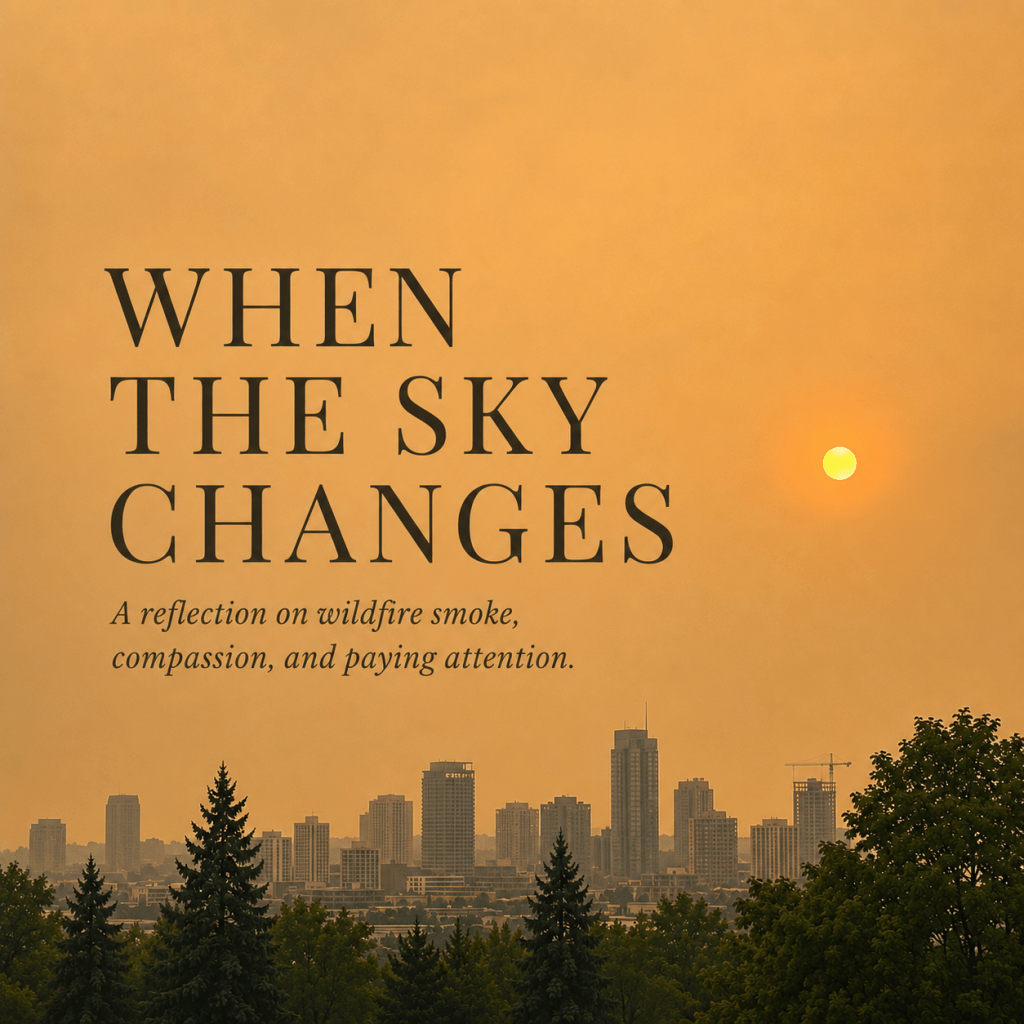
I’ve never seen the sun look like that.
It wasn’t the deep orange of a summer sunset, and it wasn’t hidden behind clouds. It hung in the sky, bright and almost impossible to look at, surrounded by an eerie yellow haze that made the middle of the day feel unfamiliar.
The whole world looked…wrong.
When I opened the back door, the smell hit me immediately.
Campfire.
Except this wasn’t the comforting smell of a backyard fire with guitars and marshmallows, or peaceful evenings at the cottage. It was heavier than that. It settled in my throat. My eyes burned. The air itself felt different.
This wasn’t fog. It wasn’t humidity.
It was smoke.
Smoke from wildfires burning hundreds of kilometres away in Northern Ontario had drifted south until it became impossible to ignore. You could smell it in your backyard. You could see it from your front porch. It found its way into open windows and lingered on your clothes.
For the first time in my life that I can remember, the weather report wasn’t just about rain or sunshine. It was about whether it was safe to breathe, whether we should wear masks or stay inside.
Summer festivals were cancelled. Outdoor recreation programs were called off. Public pools closed.
Parents checked the air quality before deciding whether their children could play outside.
It felt strange to watch summer itself pause.
From Tuesday until Saturday afternoon, many of us watched and waited as the sky changed.
There is a temptation, when something unsettling happens, to look away. To wait until it passes. To carry on as though nothing has changed.
But I don’t think that’s how we move through the world well.
Lately, I’ve been writing about paying attention. About noticing the small things that make an ordinary life meaningful. A bird at the feeder. A neighbour’s kindness. A dog asleep on the couch. Pulled pork cooking in the crock pot. The ordinary moments that quietly become the stories of our lives.
Those moments matter.
But if we only notice what is beautiful, we aren’t really paying attention.
I think we are called to become compassionate witnesses.
To witness the heartbreak as much as the beauty. The joyful as much as the painful.
That, to me, is part of being human.
Somewhere north of here, people have left their homes with only what they could carry. Firefighters have worked exhausting days and sleepless nights. Entire forests – places where families camped, where children explored, and where animals lived – have been forever changed.
I can’t stop those fires and I can’t clear the smoke from the sky.
But I can refuse to look away.
I can remember that the air filling my lungs during our morning dog walk carried with it a reminder that our lives are more connected than we sometimes imagine. What happens hundreds of kilometres away can change the colour of my sky, cancel a child’s swimming or riding lesson, and make me hesitate before opening my own front door.
Then, almost as suddenly as it arrived, the wind shifted.
A storm rolled through.
By Saturday afternoon, the smoke had cleared.
Today, the sky is blue again. The windows are open. Festivals and city events have returned. Before long, we’ll complain about the heat instead of the air quality.
I hope we do.
But I also hope I remember last week.
Not because it was beautiful. But because it mattered.
We often talk about stopping to smell the roses. Last week, the air smelled of smoke.
We don’t get to choose what the world asks us to notice. Only whether we notice at all.
Because paying attention isn’t only about collecting moments of wonder. It isn’t about creating a highlight reel or pretending life is more beautiful than it is. It’s about witnessing the world honestly – with all its beauty, all its heartbreak, and all the quiet reminders that none of us are as separate as we sometimes believe.
Sometimes, the sky changes.
Perhaps the best thing we can do is look up.


Leave a Reply